Thursday, October 29, 2015

American Homefront WWI


As over two million American soldiers boarded the transport ships bound for France. More than one million American women sustained the wartime labor force. A great many jobs, which had previously been considered “man’s work,” were being filled by women, in the factory, the shipyard, and the armed forces. Women plowed the fields, fixed the cars, delivered the mail, ran the elevators and the streetcars, and even wrote the traffic tickets.


President Wilson encouraged employers to pay female workers the same wages they had paid men but few did. Even worse, when the war was over and men returned to the workforce, a great many women were fired. Other women contributed to the war effort by volunteering. They served in the Red Cross, sold liberty bonds, and planted victory gardens. Others, like Jane Addams and Carrie Chapman Catt, raised public awareness by actively demonstrating against war and militarism.

As the war dragged on, the nation began to appreciate the valuable contribution made by women in the war effort, creating a prime opportunity for a change in women's civil liberties. On January 10, 1917, Alice Paul and Lucy Burns of the National Women's Party took action. For almost a year they paraded and picketed the White House demanding passage of a constitutional amendment granting women suffrage—the right to vote. Wilson was out of office by the time the 19th amendment was ratified, but there was no doubt that the new role of women in America during World War One was a catalyst leading to the right to vote. 

Society also had to come to grips with a new role for African-Americans. Like most Americans, African- Americans were divided in their opinions about the war. Many felt that African-Americans were victims of racism and should not support a racist government. 

At home, the war contributed to the large-scale migration of more than half a million African-Americans into the industrialized cities of the north. They provided the workforce desperately needed to produce wartime goods. In addition, immigration into America had slowed to a trickle, and many immigrants had returned to their native homelands, leaving more jobs to be filled. 

Despite the many women employed, companies were still short of workers. Many African-Americans were anxious to leave the south and its pattern of racial discrimination, low pay, and all-too-often life threatening conditions. Between 1892 and 1919, approximately three thousand African-Americans were killed by lynching, mainly in the south.
When northern manufacturing companies sent recruiting agents with free railroad tickets into the south looking for laborers, hundreds of thousands of men and women boarded trains and headed for cities like Chicago, New York and Philadelphia.

Get comfortable and watch this 9 minute video on Women in WWI. 

This 6 minute video about the Great Migration of African Americans during WWI.

One more 4 minute video about Alice Paul the suffragist. 

Comment on the Blog today. Tell us one thing you learned from each video. 

Sunday, October 25, 2015

WWI: The end of the War

The Last Battles of The Great War


In August of 1918, the Allied commanders on the western front decided to go on the offensive. Starting on August 8th, a series of battles were fought called the Hundred Days Offensive. These battles included the Battle of Amiens, the Second Battle of the Somme, and several battles along Germany's Hindenburg Line. The Germans were pushed out of France and were forced to retreat back into Germany. 


People celebrating after the armistice 
Armistice 

By the end of the Hundred Days Offensive, the German forces were exhausted and running out of food and supplies. On November 11, 1918 they requested an armistice. An armistice is when both sides agree to stop fighting while a peace treaty is negotiated. The Allies agreed to the armistice and at 11 AM on November 11, 1918 the fighting in World War I came to an end. 

Treaty Negotiations 

The Allied Nations met in Paris at the Paris Peace Conference in 1919 to decide the fate of Germany and the Central Powers. Although a number of nations took part in the negotiations, the major decisions and discussions were between the leaders of the "Big Four" nations which included Georges Clemenceau (Prime Minister of France), David Lloyd George (Prime Minister of Great Britain), Woodrow Wilson (President of the United States), and Vittorio Orlando (Prime Minister of Italy). 


The Big Four

Each of the four nations had different opinions on how Germany should be treated. President Woodrow Wilson felt that the best solution was to incorporate his Fourteen Points. He thought that Germany should not be blamed for the war or punished too harshly. However, French Prime Minister Georges Clemenceau felt that Germany was responsible for the war and should take the blame and be forced to pay large reparations. 

Treaty of Versailles 

The Treaty of Versailles was signed between the Allied Powers and Germany on June 28, 1919. This officially ended World War I. The treaty was extremely harsh on Germany. It forced Germany to "accept the responsibility for causing all the loss and damage" of the war. Germany was forced to disarm, give up land to France, and to pay reparations of 132 billion Marks (around $442 billion in 2015 money). 

New National Borders 

The map of Europe changed significantly after World War I. Several new independent countries were formed including Poland, Finland, Yugoslavia, and Czechoslovakia. Russia became the Soviet Union and the Ottoman Empire later became the country of Turkey. Germany also had to give up some land to France. 

League of Nations 

As part of the Paris Peace Conference, an organization called the League of Nations was formed. The League of Nations was formed in an effort to establish world peace. Its member countries hoped to prevent wars by helping to settle disputes between countries. The League also aimed to establish fair labor conditions, improve global health, control the global arms trade, and protect minorities in Europe. The League was officially founded by the Treaty of Versailles and had 42 founding member countries. 

Interesting Facts about the End of World War I
  • The United States did not sign the Treaty of Versailles, but established its own treaty with Germany.
  • The United States also did not join the League of Nations which was first introduced by U.S. President Woodrow Wilson in his Fourteen Points.
  • The reparations that Germany owed from the Treaty of Versailles were renegotiated several times and were not finally paid off until well after World War II.

  • Four European Empires disappeared after World War I including the German, Russian, Ottoman, and Austro-Hungarian Empires.


Watch this video about the end of WWI.

Do this map puzzle of Europe. 

Battles of WWI


Where was most of the fighting? 


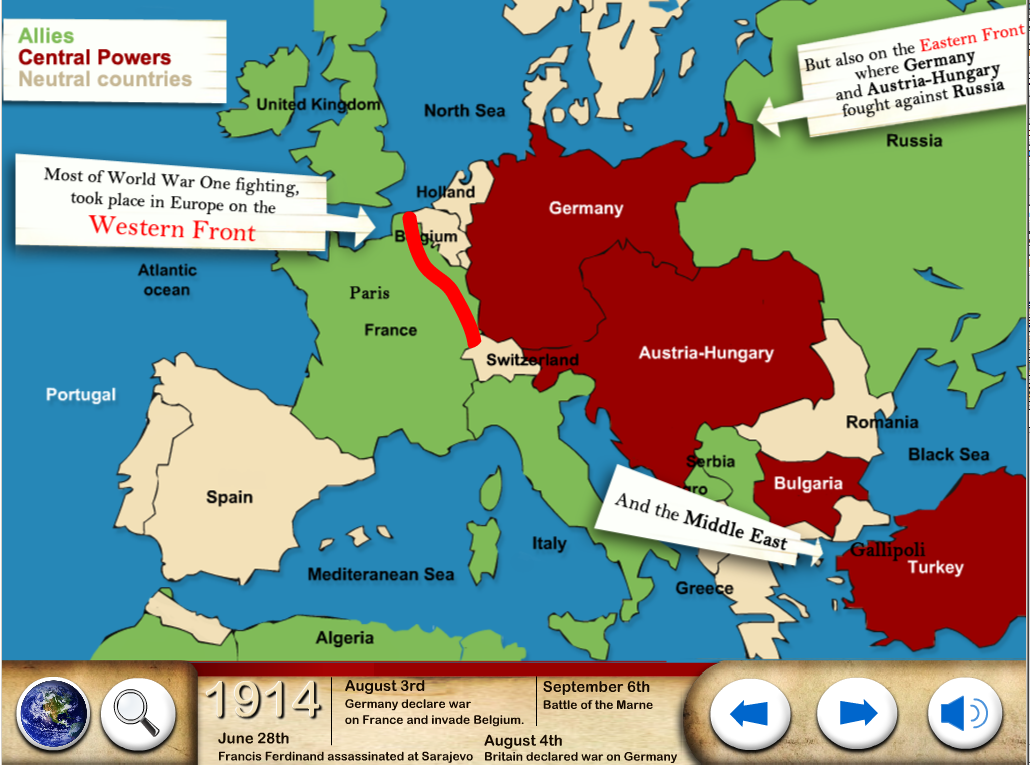
The majority of the fighting took place in Europe along two fronts: the western front and the eastern front. The western front was a long line of trenches that ran from the coast of Belgium to Switzerland. A lot of the fighting along this front took place in France and Belgium. The eastern front was between Germany, Austria-Hungary, and Bulgaria on one side and Russia and Romania on the other.

Major Battles 

A lot of the war was fought using trench warfare along the western front. The armies hardly moved at all. They just bombed and shot at each other from across the trenches. Some of the major battles during the war included the First Battle of the Marne, Battle of the Somme, Battle of Tannenberg, Battle of Gallipoli, and the Battle of Verdun. 

How did it end? 

The fighting ended on November 11, 1918 when a general armistice was agreed to by both sides. The war officially ended between Germany and the Allies with the signing of the Treaty of Versailles. 
Credit: http://www.ducksters.com/history/world_war_i/ 

Watch these two videos on the 

&

Finally, complete your worksheet using the following website. 

Tuesday, October 20, 2015

WWI: Wilson


Although World War I began in 1914, the United States did not join the war until 1917. The impact of the United States joining the war was significant. The additional firepower, resources, and soldiers of the U.S. helped to tip the balance of the war in favor of the Allies. 


When war broke out in 1914, the United States had a policy of neutrality. Many people in the U.S. saw the war as a dispute between "old world" powers that had nothing to do with them. Also, public opinion on the war was often split as there were many immigrants who had ties to both sides.


United States recruiting poster


When the Germans sunk the Lusitania in 1915, a passenger ocean liner with 159 Americans on board, the public opinion in the United States toward the war began to change. 


In January of 1917, the German leaders asked Mexico to join in the fight and in return Germany promised to return to Mexico that land that was once theirs - Texas, New Mexico, and Arizona. 


 President Woodrow Wilson gave a speech to Congress on April 2, 1917 asking for them to declare war on Germany. In his speech he said that the U.S. would go to war to "fight for the ultimate peace of the world." On April 6, 1917 the U.S. officially declared war on Germany. 


The U.S. army in Europe was under the command of General John J. Pershing. At first, the U.S. had few trained troops to send over to Europe. However, the army was quickly built up through the draft and volunteers. By the end of the war around 2 million U.S. troops were in France.


U.S. troops marching through London


The U.S. troops arrived just in time to turn the tide of the war in favor of the Allies. Both sides were exhausted and running out of soldiers. The influx of fresh troops helped to boost the morale of the Allies and played a major role in the defeat of the Germans. 

Watch this video on Woodrow Wilson (3.33)

Comment on the Blog: 
According to the video:
What are two reasons that America wished to stay out of WWI? (There are more than two) 
What slogan did Wilson use when he was running for President?  
What did joining in the War effort do for the USA’s reputation?


Saturday, August 1, 2015

WWI: Life in the trenches


Why Trench Warfare in WWI?

In the early weeks of the First World War ( summer of 1914), both German and French commanders anticipated a war that would involve a large amount of troop movement, as each side sought to gain -- or defend -- territory. 

The Germans initially swept through parts of Belgium and northeastern France, gaining territory along the way.
During the First Battle of the Marne in September 1914, however, the Germans were pushed back by Allied forces. They subsequently "dug in" to avoid losing any more ground. Unable to break through this line of defense, the Allies also began to dig protective trenches. Trenches were long, narrow ditches dug into the ground where soldiers lived all day and night.
By October 1914, neither army could advance its position, mainly because war was being waged in a very different way than previous wars.

 Forward-moving strategies such as head-on infantry attacks were no longer effective or feasible against modern weaponry like machine guns and heavy artillery; this inability to move forward created the stalemate. 

Digging trenches was seen as a temporary strategy -- or so the generals had thought --  but it evolved into one of the main features of the war at the Western Front for the next four years.


What was it like in a World War One trench?
There were many lines of German trenches on one side and many lines of Allied trenches on the other.

In the middle, was no man's land, so-called because it did not belong to either army. Soldiers crossed No Man's Land when they wanted to attack the other side.

Food in the trenches
A total of 3,240,948 tons of food was sent from Britain to the soldiers fighting in France and Belgium during the First World War. The British Army employed 300,000 field workers to cook and supply the food. At the beginning of the war British soldiers were given 10 ounces of meat and 8 ounces of vegetables a day. As the size of the army grew and the German blockade became more effective, the army could not maintain these rations and by 1916 this had been cut to 6 ounces of meat a day. Later troops not in the front-line only received meat on nine out of every thirty days. The daily bread ration was also cut in April 1917. The British Army attempted to give the soldiers the 3,574 calories a day that dieticians said they needed. However, others argued that soldiers during wartime need much more than this.

Soldiers in the Western Front were very critical of the quantity and the quality of food they received. The bulk of their diet in the trenches was bully beef (caned corned beef), bread and biscuits. By the winter of 1916 flour was in such short supply that bread was being made with dried ground turnips. The main food was now a pea-soup with a few lumps of horsemeat. Kitchen staff became more and more dependent on local vegetables and also had to use weeds such as nettles in soups and stews. The battalion's kitchen staff had just two large vats, in which everything was prepared. As a result, everything the men ate tasted of something else. For example, soldiers often complained that their tea tasted of vegetables. Providing fresh food was also very difficult. It has been estimated that it took up to eight days before bread reached the front-line and so it was invariably stale. So also were the biscuits and the soldiers attempted to solve this problem by breaking them up, adding potatoes, onions, sultanas or whatever was available, and boiling the mixture up in a sandbag.

Rats
Many men killed in the trenches were buried almost where they fell. If a trench subsided, or new trenches or dugouts were needed, large numbers of decomposing bodies would be found just below the surface. These corpses, as well as the food scraps that littered the trenches, attracted rats. One pair of rats can produce 880 offspring in a year and so the trenches were soon swarming with them.. Millions of rats infested the trenches and some grew as big as cats. 

Trench foot
Many soldiers fighting in the First World War suffered from trench foot. This was an infection of the feet caused by cold, wet and insanitary conditions. In the trenches men stood for hours on end in waterlogged trenches without being able to remove wet socks or boots. The feet would gradually go numb and the skin would turn red or blue. If untreated, trench foot could turn gangrenous and result in amputation. The only remedy for trench foot was for the soldiers to dry their feet and change their socks several times a day. By the end of 1915 British soldiers in the trenches had to have three pairs of socks with them and were under orders to change their socks at least twice a day. As well as drying their feet, soldiers were told to cover their feet with a grease made from whale-oil. 

Body Lice

Men in the trenches suffered from lice. One soldier writing after the war described them as "pale light in color, and they left blotchy red bite marks all over the body." They also created a sour; stale smell. A British soldier was quoted as saying,  "The lice were the size of grains of rice, each with its own bite, each with its own itch. When we could, we would run hot wax from a candle down the seams of our trousers, our vests - whatever you had - to burn the buggers out. It was the only thing to do. Eventually, when we got to  back, they took every stitch off us and gave us a suit of sterilized blue material. And the uniforms they took off, they burned them - to get rid of the lice."
Text taken from:http://spartacus-educational.com/FWWtrench.htm 


The truce on Christmas Day. The most beautiful video EVER. 

View this video on trenches.
This one as well....

Comment on the blog: What do YOU think would be the worst part of this experience? 


WWI: Weapons


World War I

Changes in Modern Warfare

World War I introduced many advances in science and technology into modern warfare. These advances changed the nature of warfare including battle strategies and tactics. Scientists and inventors on both sides worked throughout the war to improve weapon technology in order to give their side an edge in the fight. 

War in the Air 

World War I was the first war where the airplane was used. Initially, airplanes were used to observe enemy troops. However, by the end of the war they were used to drop bombs on troops and cities. They also had mounted machine guns that were used to shoot down other planes.


German fighter planes

Tanks 
Tanks were first introduced in World War I. These armored vehicles were used to cross "No Man's Land" between the trenches. They had mounted machine guns and cannon. The first tanks were unreliable and hard to steer, however, they became more effective by the end of the war.


A tank during the Battle of the Somme

Trench Warfare 

Much of the war along the western front was fought using trench warfare. Both sides dug long lines of trenches that helped to protect the soldiers from gunfire and artillery. The area between enemy trenches was called No Man's Land. Trench warfare caused a stalemate between the two sides for many years. Neither side gained ground, but both sides lost millions of soldiers. 

Changes in Naval Warfare 

The most dangerous ships during World War I were large metal-armored battleships called dreadnoughts. These ships had powerful long-range guns, allowing them to attack other ships and land targets from a long distance. The main naval battle in World War I was the Battle of Jutland. Besides this battle, Allied naval ships were used to blockade Germany to prevent supplies and food from reaching the country. 

World War I also introduced submarines as a naval weapon in warfare. Germany used submarines to sneak up on ships and sink them with torpedoes. They even attacked Allied passenger ships such as the Lusitania. 

New Weapons

  • Artillery - Large guns, called artillery, were improved during World War I including anti-aircraft guns to shoot down enemy planes. The majority of the casualties in the war were inflicted using artillery. Some large artillery guns could launch shells nearly 80 miles.
  • Machine gun - The machine gun was improved during the war. It was made much lighter and easier to move around.
  • Flame throwers - Flame throwers were used by the German Army on the western front in order to force the enemy out of their trenches.
  • Chemical weapons - World War I also introduced chemical weapons to warfare. Germany first used chlorine gas to poison unsuspecting Allied troops. Later, the more dangerous mustard gas was developed and used by both sides. By the end of the war, troops were equipped with gas masks and the weapon was less effective.
 
Soldiers in gas masks firing a machine gun 
Interesting Facts about WWI Changes in Modern Warfare
  • Tanks were initially called "landships" by the British. They later changed the name to tank, which was what the factory workers called them because they looked like a large water tank.
  • The main form of transportation of troops during the war was the railroad. Armies would build new railroads as they advanced.
  • British soldiers in the trenches used a bolt-action rifle. They could fire around 15 shots in a minute.
  • Large artillery guns needed as many as 12 men to aim, load, and fire them.
Watch the following videos:


Airplanes used in war for the first time! (7.00)


Comment on the blog and tell us one fact that you learned from EACH of the three videos. 


Thursday, July 30, 2015

WWI: Propaganda


During World War I, the United States established a department of the government whose sole purpose was to convince Americans that they should support the war effort. Posters were made, songs were written and performed, films were produced, and advertisements were produced.


Propaganda is ideas, information or rumors spread to influence people to believe or act a certain way. 

Because the government was very clever in the ways they presented the war, many men enlisted in the army during WWI due to the encouraging visuals they saw on posters and in the newspaper and magazines.   

Propaganda posters in WWI used many techniques to influence men by appealing to their emotions of persuasion, fear, guilt, confrontation and accusation and were designed to be advertising and appealing.

These strategies included:

  • Emphasizing  patriotism, making men feel like they should be proud to protect their country with their own strength;
  • Creating an exaggeration of hatred and fear towards the Germans;
  • Making those who were not enlisting feel cowardly;
  • Emphasizing the sense of masculinity and bravery in the armies;
  • And glorifying army life, making the men feel as though recruiting was a great adventure all should embark on.
Many posters presented a distorted image of war, making the soldiers in the pictures seem as though they were the proudest men of the country, and making the conditions seem superior.  

In actual fact, this was not true. Most men suffered painful deaths and those who survived had experienced horrific injuries.

The government also used propaganda to promote fear and hatred of the Germans. 
This poster depicts the Germans as a blood hungry
skeleton that brutally takes lives of men and drinks their blood.
                                            
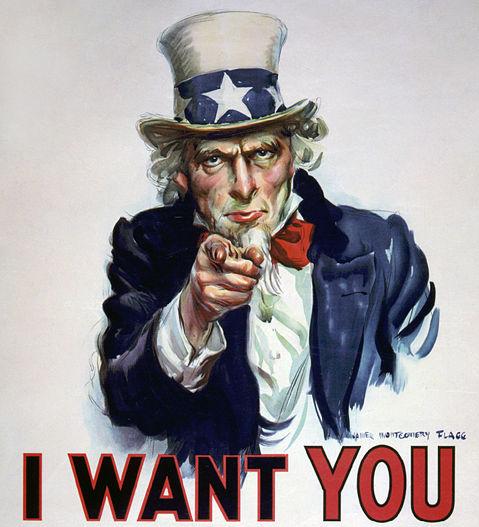
I WANT YOU!  PROTECT OUR NATIONS HONOR ....
this is trying to promote ownership and make men feel
like they are responsible to fight. It would be dishonorable NOT to!!
We will all work together to win this war! 

While England and France were depicted as “civilization,”
Germany was shown as a “mad brute” — here, a giant, drooling
gorilla weilding the club of German kultur (culture) and carrying
the limp, half-naked body of a woman. As a result of propaganda
like this, German Americans — many of whose ancestors had
lived in America for centuries — faced persecution during the war.
                                                      
Americans were not eager to enter the war, and Americans of German 
ancestry tended to support Germany, not Britain and France. 
The government’s first task was to convince citizens that they 
must support the war effort without reservation. Here, a woman 
clad in the stars and stripes represents America and American liberty.
                                    
This famous portrayal of “Uncle Sam” first appeared during World War I.


Planting “Victory Gardens” on the home front was encouraged because
Americans needed to keep their troops (and their allies) fed by sending
 mass quantities of food to Europe. In order to avoid a shortage
at home they planted gardens at hom
e. 


Assignment: 

View this (1:51) video

Look online and find one example of propaganda that employs one of  the strategies or techniques listed above. You can not choose one that I have already shown you on this page. Print it out (it doesn't have to be large or in color) and then write what type of strategy you think it employs. What emotion or feeling is the poster is trying to evoke?

Hint: Google: WWI Propaganda (images) 

Comment on the blog:
How did Creel make an unpopular war popular and what are some ways in which he accomplished this task?